
Visualization and Reading Comprehension: The Skill Schools Don’t Teach
Janel Nansenn · Jul 14

If your child can read the words on a page but can’t tell you what they just read, you’ve probably wondered what’s going wrong. Maybe you’ve tried more reading practice. Maybe you’ve bought workbooks or hired a tutor. Maybe the teacher says your child just needs to “try harder” or “slow down.”
But what if the problem isn’t effort, speed, or practice?
What if there’s a fundamental skill, one that strong readers use automatically, that your child simply never learned?
That skill is visualization: the ability to create mental images from text. And it’s the single most important factor in reading comprehension that most schools never explicitly teach.
What Is Visualization in Reading?
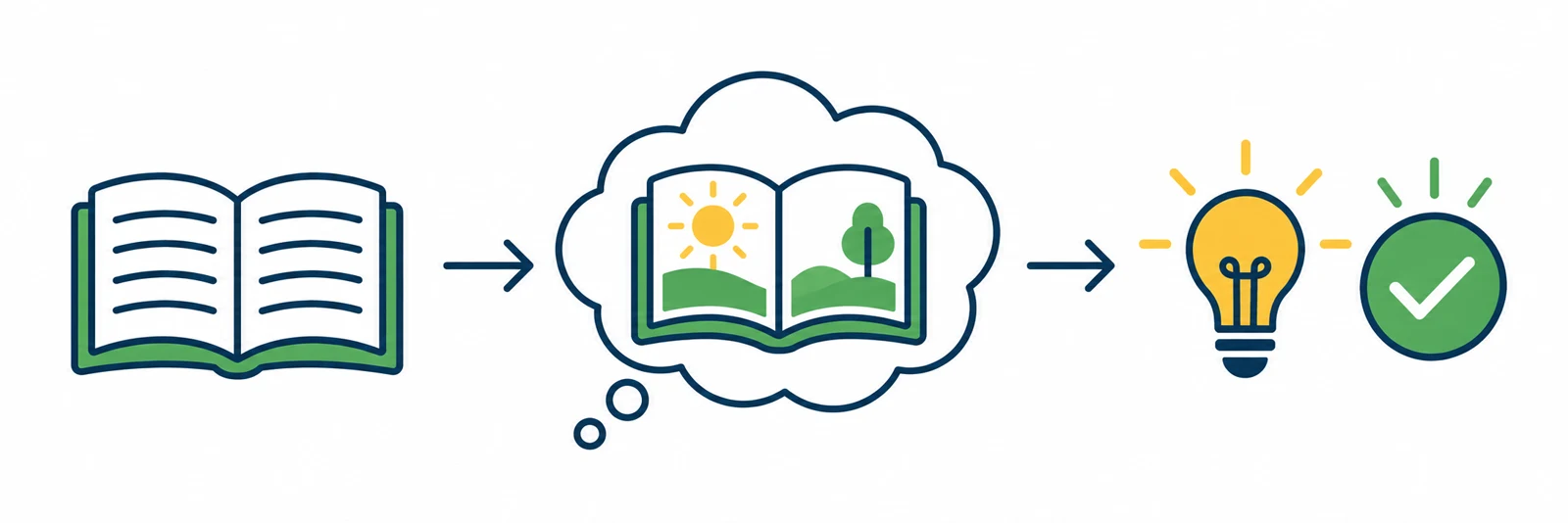
When you read a novel, what happens in your mind? If you’re like most proficient readers, you “see” the story. You picture the characters, imagine the setting, watch the action unfold like a movie in your head. You might hear the dialogue, feel the tension, or sense the mood of a scene.
This is visualization, and it’s not just a nice bonus. It’s the core mechanism that turns printed words into meaning, memory, and understanding.
Visualization is what allows you to:
Understand what you read, because you’re building meaning, not just processing symbols
Remember what you read, because images stick in memory far better than strings of words
Make inferences, because you can “see” gaps in the mental picture and fill them in
Think critically, because you can manipulate and examine the mental model you’ve created
Stay engaged, because your brain is actively creating, not passively receiving
For strong readers, this happens automatically. They don’t even think about it. But for struggling readers, it doesn’t happen at all. And that’s where the breakdown occurs.
Why Some Children Don’t Visualize When They Read
If visualization is so natural for proficient readers, why don’t all children do it? There are several reasons, and none of them have to do with intelligence:
Over-Reliance on Decoding
In the early grades, so much emphasis is placed on learning to decode, sounding out words, building phonics skills, developing fluency, that some children never make the leap from decoding to meaning-making. They get stuck in “word-calling” mode, where reading means pronouncing words correctly rather than understanding them.
Screen Culture and Passive Consumption
Today’s children grow up with screens that provide all the imagery for them. TV shows, YouTube videos, video games, these all supply constant visual stimulation. The brain doesn’t need to generate its own images. When these kids encounter a book, which requires them to create their own imagery, they don’t know how.
It Was Never Taught
Here’s the uncomfortable truth: schools assume visualization happens naturally. Reading curricula teach comprehension strategies, finding the main idea, identifying cause and effect, making predictions, but these strategies all depend on the student already being able to make meaning from text. If a child can’t visualize, comprehension strategies are like giving someone a map when they don’t know how to read maps.
Processing Differences
Some children’s brains process information differently. They may be strong visual-spatial thinkers in other areas but haven’t connected that ability to reading, and need explicit guidance to activate visual processing during reading.
The Research Behind Visualization and Comprehension
This isn’t just theory. The connection between visualization and reading comprehension is well-supported by research.
Studies in cognitive psychology have consistently shown that readers who generate mental images while reading demonstrate significantly better comprehension and recall than those who don’t. Dual coding theory, developed by psychologist Allan Paivio, explains why: when information is encoded both verbally (as words) and visually (as images), it creates two pathways to memory instead of one. This makes the information easier to understand, easier to remember, and easier to retrieve later.
Research on mental imagery instruction has found that teaching students to visualize while reading produces measurable improvements in:
Reading comprehension scores
Recall and retention of information
Inferential thinking
Engagement and motivation
The key finding? Visualization can be taught. It’s not a fixed trait, it’s a trainable skill. And when students learn it, everything about their reading changes.
Janel Nansenn, M.A., the Educational Therapist who developed Read-A-Rific, saw this research confirmed thousands of times in her clinical practice over 25 years. Student after student who had been labeled “lazy,” “unfocused,” or “not a reader” transformed once they learned to visualize. The words on the page finally meant something because their brain was finally processing them the way proficient readers do.
What Visualization Looks Like in Practice
So what does it actually look like when a child learns to visualize? Let’s walk through an example.
Without visualization: A child reads: “The old man walked slowly through the foggy streets, pulling his coat tighter against the cold.” What happens in their brain: They process the individual words. Old. Man. Walked. Foggy. They might understand each word, but there’s no picture, no scene, no meaning that sticks. Ten minutes later, they can’t tell you what they read.
With visualization: The same child reads the same sentence. But now they’ve been trained to create a mental image. They “see” an elderly man, maybe hunched over, gray-haired, shuffling down a cobblestone street with fog swirling around him. They feel the cold. They picture him tugging his coat collar up.
That image sticks. They remember it. They can make inferences, maybe the man is lonely, maybe it’s early morning, maybe something is about to happen. They’re inside the text, not just skimming across its surface.
That’s the difference visualization makes. And it applies to everything, stories, textbooks, science articles, math word problems, even test questions.
Why Schools Don’t Teach This Skill
If visualization is this important, why isn’t it a core part of reading instruction?
Curriculum Constraints
Schools are under enormous pressure to cover required standards. Reading instruction focuses on measurable skills, phonics, fluency, vocabulary, and comprehension strategies that can be tested. Visualization is harder to test on a standardized assessment, so it gets pushed aside in favor of skills that directly map to test questions.
Assumption of Automaticity
Most reading curricula assume that as students learn to decode and build vocabulary, comprehension will follow naturally. For many students, it does. But for a significant portion, estimates suggest 25-40% of students, it doesn’t. These are the kids who can read the words but can’t understand the text, and they fall further behind each year.
Teacher Training Gaps
Many teachers haven’t been trained in visualization-based instruction. They know comprehension strategies, but they don’t know how to teach the underlying cognitive process that makes those strategies work. It’s not a failure of teachers, it’s a gap in teacher preparation programs.
The Strategy Problem
Do comprehension programs actually work? Many popular ones focus on strategies like “reread,” “look for context clues,” or “use a graphic organizer.” These can be helpful for students who already comprehend reasonably well, but they don’t address the root cause for students who don’t. It’s like telling someone who can’t swim to just “use your arms more.” The underlying skill has to be built first.
How to Tell If Your Child Isn’t Visualizing
Not sure if your child is a visualizer? Here are some practical ways to find out:
The Retelling Test: After your child reads a passage, ask them to retell it in their own words. Visualizers will naturally describe scenes, characters, and events with detail. Non-visualizers will give vague, minimal responses or try to recall exact wording from the text.
The “What Did You See?” Question: Ask your child, “What did you picture in your mind while you were reading?” If they look at you blankly or say “nothing,” that’s a clear sign they’re not visualizing.
The Detail Question: Ask about specific sensory details that weren’t stated in the text but would be part of a mental image. “What color was the character’s hair?” “What did the room look like?” Visualizers will have answers (even made-up ones) because they created a picture. Non-visualizers won’t.
The Memory Test: Read a descriptive paragraph to your child, then wait 30 minutes and ask them to recall it. Visualizers will remember the scene; non-visualizers will remember little or nothing.
If you’re seeing these signs, our free comprehension checklist can help you identify specifically where your child’s comprehension is breaking down.
How to Help Your Child Build Visualization Skills
Start With Read-Alouds
Read a passage aloud to your child and stop after every few sentences. Ask, “What do you picture?” Help them build the image by asking prompting questions: “What does the character look like? What’s happening around them? What sounds might you hear?”
Use Picture-Rich Texts, Then Transition
Start with books that have illustrations. Have your child look at the picture, then read the corresponding text and compare their mental image to the illustration. Gradually move to texts without pictures, encouraging them to create the images themselves.
Draw What They Read
After reading a paragraph, have your child sketch what they imagined. It doesn’t have to be artistic, stick figures are fine. The act of drawing forces the brain to create and externalize a mental image.
Practice With Short Passages Daily
Visualization is a skill that builds with practice. Even five minutes a day of deliberate visualization practice, reading a short passage, creating a mental image, describing it, can make a significant difference over time.
Use a Structured, Systematic Program
While at-home practice helps, a structured program that systematically builds visualization skills from simple to complex produces the fastest and most lasting results. Read-A-Rific’s programs, available for 3rd and 4th graders and 5th and 6th graders, were designed specifically to train the visualization process in a systematic, daily routine. Each session takes about 15 minutes and builds on the previous one, developing the mental processing habit over 60 sessions.
The Transformation Parents Describe
When children learn to visualize, the changes are often dramatic, and they extend far beyond reading class.
Parents report that their children:
- Start remembering what they read without rereading
- Can retell stories and explain concepts in their own words
- Perform better on tests across all subjects
- Become more confident and willing to read independently
- Need fewer reminders and less help with homework
- Show improved focus and attention during tasks that involve listening or reading
This makes sense when you think about it. Visualization isn’t just a reading skill, it’s a thinking skill. Once a child learns to create mental images from language, they process all language more effectively, whether it’s reading a book, listening to a teacher, or following multi-step directions.
FAQ: Visualization and Reading Comprehension
Can visualization really be taught, or is it something kids are born with?
Visualization is absolutely a learnable skill. While some children develop it naturally, many don’t, and they can be explicitly taught. Research consistently shows that visualization instruction produces measurable improvements in reading comprehension. Read-A-Rific’s programs are built specifically to train this skill through systematic daily practice.
My child is a strong visual learner in other areas, why can’t they visualize while reading?
Visual learning ability and reading visualization are related but not identical. Your child may be great at understanding diagrams or maps but hasn’t learned to activate that visual processing during reading. Reading requires generating images from words alone, which is a specific skill that needs practice. The good news is that their existing visual strengths make them well-suited to learn this quickly.
At what age should children start learning to visualize while reading?
Children as young as 3rd grade can benefit from visualization instruction, and it’s appropriate for any age. That said, the sweet spot for intervention is typically 3rd through 6th grade, when academic reading demands increase dramatically but the brain is still highly responsive to this type of training.
How long does it take for visualization training to work?
Most families see initial improvements within a few weeks of consistent practice. Read-A-Rific’s programs are designed as 60-session sequences, about 12 weeks at 15 minutes per day. By the end, students have typically built a strong, automatic visualization habit that carries into all their reading.
Why doesn’t my child’s school teach visualization?
Most schools focus on comprehension strategies that are easier to test and align with curriculum standards. Visualization falls into a gap between reading instruction and cognitive skills training. It’s not that schools don’t value it, it’s that their curricula weren’t designed to teach it explicitly. That’s exactly why programs like Read-A-Rific exist: to fill the gap that schools leave behind.
How is visualization different from imagination?
Imagination is open-ended and creative, making up anything you want. Visualization in reading is more structured: it means creating mental images that are guided by and grounded in the text. It’s not about inventing things; it’s about accurately representing in your mind what the author describes. This distinction matters because visualization leads to comprehension, while undirected imagination might lead a child away from the text.